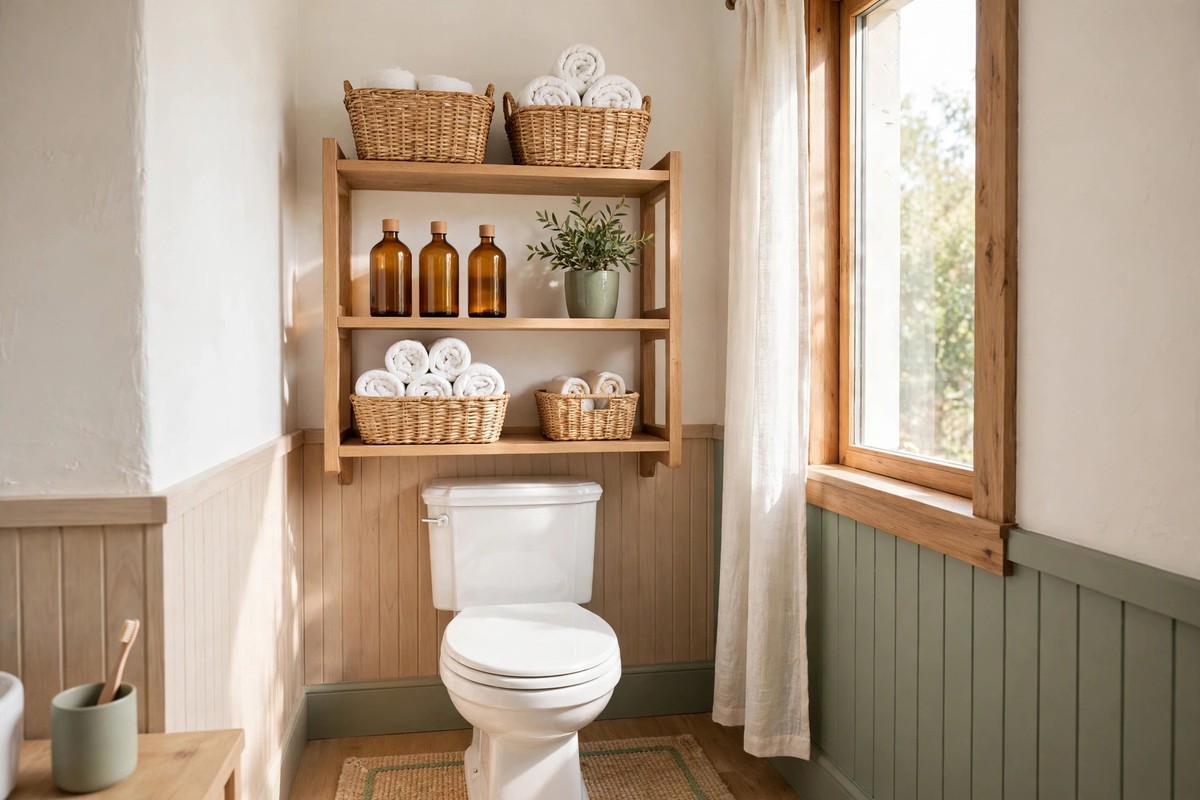
The wall above a toilet is often empty, even in bathrooms with almost no storage. Good over the toilet storage turns that blank spot into a place for towels, toilet paper, and daily supplies.
Shelves, cabinets, and baskets all work here, but they solve different problems. Open shelves are easy to reach, cabinets hide clutter, and baskets add storage with no tools. Most setups take 20 to 60 minutes and need only a tape measure, a level, and a pencil.
1. Measure First for Over the Toilet Storage That Fits
Most standard toilets are about 20 inches wide, with a tank 7 to 8 inches deep. The unit must clear both, with room to lift the tank lid for repairs.
Width and height. Add at least 2 inches on each side of the toilet. Most freestanding units are 23 to 25 inches wide inside the legs. Leave 10 to 12 inches between the top of the tank and the lowest shelf, so the flush handle moves freely and the lid can come off.
Depth and total height. Shelves 9 to 11 inches deep hold folded towels and standard bins well. Deeper than 12 inches can feel crowded. Most units are 60 to 66 inches tall, so measure floor to ceiling if a light or window sits above the toilet.
2. Shelves: The Most Flexible Over the Toilet Storage Option
Freestanding shelf units. These stand on the floor on either side of the toilet, with 2 or 3 shelves above the tank. Assembly takes about 30 to 45 minutes. They suit tile walls and rentals where drilling is not allowed. The downside is that legs take floor space and trap dust.
Floating shelves. These mount to the wall, usually 24 to 30 inches wide and 6 to 8 inches deep. Stack 2 or 3 shelves 12 to 14 inches apart for towels, jars, and small bins. The floor stays clear, so the room looks lighter. Each shelf holds less weight than a frame, and solid wall anchors are a must.
Open shelves are easiest for daily items, since nothing has a door to open with wet hands. They show dust, so group items in bins.
3. Cabinets: Best When Hidden Storage Matters
Wall cabinets. A cabinet about 24 inches wide, 8 inches deep, and 24 to 30 inches tall offers 2 shelves inside. It keeps medicine and personal items out of sight. Installation takes 45 to 60 minutes and must hit studs or use strong anchors.
Freestanding cabinets. These combine legs that straddle the toilet with an enclosed cabinet on top, often plus a small open shelf. They hold more than wall cabinets, but cost more and take up more visual space.
A simple rule helps: hide what is ugly or private, like cleaning products, and display what is soft and used often, like towels.
4. Baskets and Bins: Low-Cost, No-Tool Storage
Baskets on a single shelf. One wall shelf at 48 to 54 inches from the floor, plus 2 or 3 baskets about 10 inches wide, creates grouped storage. Use one basket for spare toilet paper, one for hair tools, and one for cleaning wipes.
Bins on a freestanding unit. Fabric or plastic bins 10 to 11 inches wide fit most standard shelves. They stop small bottles from tipping and let a whole category be pulled down at once.
A basket on the tank. In the smallest bathrooms, a low, flat tray on the tank lid can hold 1 spare roll and tissues. Keep it light and leave room to remove the lid. This is a short-term fix, not a full plan.
Baskets cost the least and need no installation, but they hold less and offer no privacy alone. They work best as part of a shelf or cabinet setup.
5. How to Arrange Items So the Space Stays Usable
Lowest shelf. Keep daily items here: a spare roll, a small bin of wipes, and one folded hand towel. Keep this shelf light so it is easy to clean.
Middle shelf. Use this level for folded bath towels. A bath towel folds to about 10 by 14 inches, so an 11-inch-deep shelf holds a stack of 3 or 4. Roll towels if shelves are shallow; rolled towels fit 8-inch-deep spaces better.
Top shelf. Store light, rarely used items here, such as backup soap or cotton balls. Avoid glass jars and heavy bottles up high, since they are harder to lift down safely. Leave about 20 percent of each shelf empty, or taking one item out means moving three others.
6. Renters and Small Bathrooms: No-Drill Choices
Freestanding units. Most should be secured with adhesive wall straps if a tip risk exists, especially with children in the home. After assembly, press gently at the top to check stability.
Go narrow. In bathrooms under 40 square feet, a unit under 24 inches wide and under 10 inches deep usually feels best. If a window blocks the wall, use a door hook rack for towels instead and keep the over-toilet area for shelves only.
What to Buy
3-tier over-toilet storage shelf / space saver, typically $30–$50. Pro: Adds three shelves in one purchase and fits most toilets without drilling. Con: Legs collect dust and frames can wobble on uneven floors, so skip if the floor is very uneven.
Floating shelves, set of 3, typically $25–$35. Pro: Keeps the floor clear and shelves can be spaced for tall bottles or towels. Con: Needs solid anchors, so skip if drilling is not allowed.
Narrow bathroom cabinet under 12 inches wide, typically $55–$70. Pro: Hides clutter in a slim footprint; this is the splurge option. Con: Holds less than a full-width cabinet, so skip if large towel storage is the main need.
Foldable fabric storage bins, 6-pack, typically $20–$28. Pro: Groups small items on any shelf and folds flat when not in use. Con: Fabric sags with heavy bottles, so skip for full shampoo bottles.
Over-door hook rack, typically $12–$22. Pro: Adds towel storage with no tools and no holes. Con: Can stop some doors closing fully, so skip if the door gap is very tight.
Mistakes to Avoid
- Buying before measuring tank width, tank depth, and height to the first shelf.
- Storing heavy glass bottles or chemicals on the highest shelf.
- Blocking access to the tank lid or the water shut-off valve.
- Filling every inch of shelf space, which makes items hard to reach.
Frequently Asked Questions
How much space should be left between the tank and the first shelf?
Leave 10 to 12 inches. That lets the tank lid be removed for repairs and keeps the flush handle clear. Less space often causes problems the first time the toilet needs a simple fix.
Can over the toilet storage work in a rental?
Yes. Freestanding units and baskets need no drilling and remove cleanly. Floating shelves and wall cabinets need holes and anchors, so they usually need the landlord's permission first.
What should not be stored over a toilet?
Avoid heavy items, breakable glass, and anything ruined if it fell in water. Medicines that must stay dry and secure are better in a closed cabinet away from steam.
How is the area kept clean?
Choose bins with smooth sides that wipe clean, and leave a gap behind the unit for a duster. Open shelves collect dust faster than cabinets, so a quick weekly wipe helps.
Over the toilet storage works best when the style matches the real need: shelves for easy reach, a cabinet for hidden storage, or baskets for a low-cost start. Save this post to your bathroom board on Pinterest for later, so the measurements are handy when it is time to shop.